

xkcd+
Squid Ink
I installed xkcd+ expecting a simple way to read xkcd, and that is exactly where its appeal begins. This free comics app from Squid Ink focuses on one clear activity instead of trying to become a general news reader, social network, or entertainment hub. After the first few sessions, I found myself judging it less by the novelty of having xkcd in a separate app and more by a practical question: does it make returning to the comic easier often enough to deserve a permanent place on my phone?
My answer is mostly yes, but with an important qualification. The app is strongest for readers who already enjoy xkcd and want a focused reading experience. It is less compelling for someone who only occasionally looks at a strip through a browser or another comic service. That distinction matters because a dedicated reader has to earn its space after the first week, when the pleasure of trying something new has worn off.
From an appealing first week to a useful long-term habit
Why the first sessions feel so natural
The first-week appeal comes from the narrow purpose. I do not have to move through unrelated feeds or search around for the latest strip before reading. Opening an app built specifically around xkcd creates a small, repeatable ritual: launch it, read, think about the joke, and close it. That simplicity suits the comic itself, which often rewards a quiet moment rather than a long browsing session.
I also like the difference between reading a strip deliberately and encountering one by accident in a crowded social feed. In a feed, the comic competes with notifications, comments, videos, and other posts. Here, the comic is the reason I opened the app. That makes the experience feel calmer, even though the underlying activity is still just reading a single-panel or multi-panel webcomic.
The app belongs in the comics category, and that description is more useful than it may initially sound. It signals that this is not trying to replace a full digital library or a magazine subscription. Its value depends on how much you appreciate xkcd’s particular combination of science, programming, mathematics, language, and deliberately dry humor. If those subjects usually leave you cold, a polished reading interface will not change the basic fit.
Related News

Why WhatsApp Messenger Still Makes Everyday Communication Feel Easy

Jurassic World: The Game Is the Better Dino Tycoon for Strategic Players

Threads in Real Life: Who Should Join, Lurk, or Leave

How SHEIN Turned Shopping Into an Endless Content Feed

How to Make Fortnite Feel Smarter on Mobile

Should You Switch to Microsoft Outlook on Mobile?
For an existing fan, the low commitment is a real advantage. I can use it during a short break without feeling that I need to catch up on a huge catalog. A quick visit before work, during a commute, or while waiting for an appointment can be enough. The app turns a familiar comic into a small daily or occasional habit rather than an activity that demands planning.
A realistic everyday use case
My most convincing use case was a short evening pause. Instead of opening a social app and losing time to an endless stream, I opened xkcd+, read the available comic, and put the phone down. That sounds modest, but it is exactly the kind of modest interaction that can make a dedicated app worthwhile. It gives me a defined stopping point.
That same quality may appeal to parents, students, developers, researchers, and anyone who enjoys clever technical humor but does not want a large entertainment platform. The content can work as a quick mental reset, although some jokes are more rewarding when I slow down and consider the reference behind them. I would not describe every visit as instantly accessible; part of the fun is accepting that a strip may require context or a second look.
Gallery
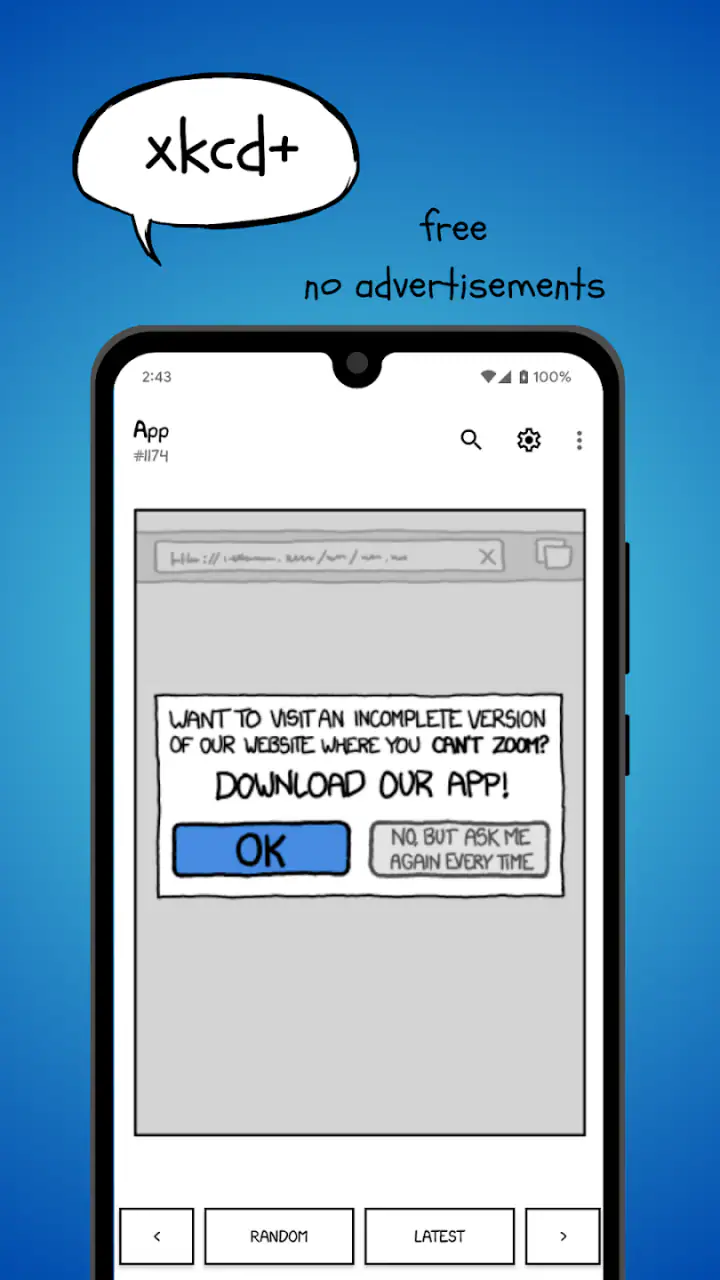
During the first week, I recommend treating the app as a reading destination rather than an always-on notification source. The habit is healthier when I decide to check it at a natural point in the day. I found that opening it with a specific intention—read the latest comic, revisit a memorable idea, or take a brief break—made the experience feel more satisfying than repeatedly checking for something new.
What makes it different from the usual alternatives
The usual alternative is a browser bookmark. A browser is more flexible and may be the better choice if I want to move between xkcd and other websites, search broadly, or avoid installing another app. It also keeps everything in one place. The trade-off is that the reading experience becomes tied to browser tabs, address bars, and the distractions of the wider web.
Another alternative is discovering strips through social media or an aggregator. That approach is convenient when I already spend time there, but it can bury the comic among unrelated material and may encourage passive scrolling. A focused app has less variety, yet that limitation is also its point. I open it for one recognizable kind of content, not for an unpredictable stream.
For me, the strongest comparison is not about having more features. It is about reducing friction between the decision to read and the act of reading. If that small reduction is meaningful to you, this app has a clear reason to exist. If reaching xkcd through your current browser routine already feels effortless, the difference may be too minor to matter.
What to expect from the current release
The current version is 1.1, and I approached it as a focused reader rather than a large, constantly changing platform. That expectation helped me evaluate it fairly. I did not need a long onboarding process or a complicated setup before reading. The free price also makes experimentation easy: I can try it without turning the decision into a subscription calculation.
It is available for devices running Android 9 or later, which is worth checking before planning to use it on an older phone or tablet. The age rating is Everyone, so the app is positioned as suitable for a broad audience. In practice, the more meaningful suitability question is not age but taste: xkcd’s references and humor can be specialized, and younger readers may not connect with every strip even when the app itself is broadly accessible.
Where the month-to-month value comes from
After the novelty fades, the app’s recurring value depends on consistency. A dedicated reader is useful when it becomes the place I instinctively go for xkcd, not merely an icon I remember from the week I installed it. The app has a chance to become that place because it removes the need to reconstruct the same browsing path each time.
Still, the value is naturally limited by the pace and size of the comic experience. This is not a broad comics library where I can spend an hour exploring different artists and genres. If I want variety, I need another service. That is not a defect in itself, but it means I should judge xkcd+ as a specialized tool, not as my only comics app.
One useful way to keep it relevant is to attach it to an existing routine. I might open it with my morning coffee, during a lunch break, or at the end of a study session. The important point is to use it as a small, bounded habit. Because the app is so focused, it works best when I want a brief reading moment rather than when I am searching for a large amount of content.
I also think it suits readers who enjoy returning to ideas. Some xkcd strips are funny immediately; others become better after I recognize the technical or cultural reference. That gives the app a little more staying power than a disposable joke feed. The recurring value is not just the act of seeing something new, but having a compact source of material that can prompt curiosity or conversation.
How to decide whether it deserves a permanent spot
My practical test is simple: after installing it, I would leave it on the phone if I regularly choose it over a browser bookmark. I would not keep it merely because it is free. Free storage is still storage, and an app that I never open adds clutter even when it costs nothing.
For a committed xkcd reader, the answer is likely favorable. The app creates a direct path to a familiar comic and makes short visits feel intentional. For a casual reader, I would first ask whether the dedicated format changes anything about the habit. If I already read every new strip as soon as it appears elsewhere, the separate app may offer convenience but not a transformative improvement.
A useful compromise is to keep the app for a trial period and observe behavior rather than enthusiasm. The first few days measure curiosity; the following weeks measure usefulness. If I still open it when I am not thinking about the installation itself, it has earned its place. If I only remember it when reviewing my apps, the browser is probably enough.
The maintenance burden is pleasantly small, but not zero
The maintenance burden appears low because the app is narrowly focused and free. I do not have to manage a paid plan or build a large personal library simply to enjoy its central purpose. That makes it easier to keep installed than a service that demands regular account decisions, downloads, or collection management.
However, low maintenance should not be confused with guaranteed long-term usefulness. I still need to remember that the app exists and decide whether it fits my reading routine. A dedicated reader can become invisible if I do not give it a place in the day. The best maintenance strategy is behavioral rather than technical: use it at a predictable moment, then close it when the reading is done.
I would also avoid treating it as a replacement for every way of following xkcd. A browser remains useful when I want broader web context, and another comics application may be better when I want multiple creators in one session. Keeping those roles separate prevents disappointment. xkcd+ can be the focused option without needing to become the universal one.
For families or shared devices, the Everyone rating makes the app straightforward to consider, but I would still remember that content suitability and content appeal are different things. A broadly suitable rating does not mean every reader will understand the jokes or references. The app is most rewarding when the user enjoys thinking through technical or intellectual humor.
Where fatigue can set in
The first source of fatigue is repetition of format. Even when the writing is clever, I may not want the same kind of comic every time I pick up my phone. A focused app cannot solve that without abandoning its identity. If I need visual variety, serialized stories, manga, or a larger selection of creators, I should use a broader comics platform instead.
The second source is the uneven accessibility of the humor. A strip can depend on a programming concept, a scientific idea, a wordplay detail, or a very specific internet reference. I enjoy that intellectual texture, but it also means the experience is not uniformly effortless. Some visits produce an immediate laugh; others produce a pause, a search for context, or no reaction at all.
The third is the risk of confusing convenience with depth. A dedicated app can make reading easier, but it does not automatically create more content or make every strip more memorable. If I expect a full archive-management system, extensive personalization, or a rich discovery layer, I may find the focused approach too restrained. The app’s discipline is its strength and its boundary.
There is also a habit-related fatigue that appears with many single-purpose apps: I may install it with good intentions and then forget it among more demanding applications. That is why I would not recommend enabling a routine simply because the app exists. It earns long-term value only when its small reading session fits naturally into my day.
Who should use it, and who should skip it
I recommend xkcd+ to readers who already know they enjoy xkcd, want a cleaner path to the comic, and appreciate a short, self-contained reading break. It is especially suitable for someone who dislikes social feeds and wants to avoid the distraction of a general browser session. The free price lowers the risk of trying it, while the Everyone rating keeps the app broadly approachable.
I would also suggest it to people who enjoy revisiting technical jokes and discussing the ideas behind them. The best experience is not always a rapid swipe through several items. Sometimes the reward comes from noticing the wording, recognizing the reference, and letting the joke sit for a moment. That makes it a better fit for reflective readers than for anyone seeking constant novelty.
I would skip it if I rarely read xkcd, if I want a large multi-creator comics catalog, or if my browser already gives me an equally convenient routine. I would also skip it as a primary comics app if I expect long reading sessions, serialized storytelling, or strong discovery tools. In those cases, a broader service is the more sensible choice, and this focused reader may feel narrow rather than refreshingly simple.
My long-term verdict
xkcd+ earns lasting space when convenience becomes a habit, not merely when installation feels exciting. In my experience, its strongest quality is restraint. It gives xkcd a dedicated doorway and does not ask me to turn a quick comic into a larger digital commitment. That makes it easy to recommend to an existing fan who wants a straightforward reading routine.
Its limitations are equally clear. The app cannot provide the variety of a general comics platform, and its humor will sometimes be too specialized or simply not in the mood I want. Readers who need extensive features or a broad content library should choose a different option. The focused design is valuable only if the focus matches what I actually want to read.
Squid Ink’s app is therefore best understood as a small, purposeful companion rather than an all-purpose comics destination. With its current version, free access, support for Android 9 and later, and broad Everyone rating, it is easy to try and uncomplicated to keep. I would install it for regular xkcd readers, give it a place in an existing daily routine, and judge it after the novelty has passed. If the app still gets opened for that quiet, self-contained reading moment, it has done enough to justify staying.
FAQs for xkcd+
What is xkcd+ and what can I do with it?
xkcd+ is an unofficial reader for the popular xkcd webcomic, designed to make browsing comics more convenient on a mobile device. It typically lets you view current and older comics, read the original titles and explanations, browse the archive, and discover random entries. Its main appeal is a cleaner, more focused way to enjoy xkcd without opening the website in a regular browser.
Does xkcd+ require an internet connection?
An internet connection is generally needed to download the latest comics, retrieve archive content, and load additional information such as comic explanations or metadata. Depending on the version and device, comics that have already been opened may remain temporarily available through local caching, but users should not assume that the complete archive works offline. Downloading content over Wi-Fi is recommended if you want to reduce mobile data usage.
Is xkcd+ an official app created by Randall Munroe?
xkcd+ should be treated as an unofficial third-party application unless its store listing clearly states otherwise. The xkcd comics are created by Randall Munroe and published through the official xkcd website, while independent apps generally provide an alternative interface for accessing that material. Before installing, review the developer name, privacy policy, permissions, and store description so you understand the app’s relationship with the original comic.
Is xkcd+ free to download, and does it contain advertisements or in-app purchases?
The availability of free features, advertising, and optional purchases can vary according to the specific xkcd+ release and whether you are using Android or iOS. Some versions may offer the basic comic reader at no cost, while others can include ads, donations, premium options, or different monetization policies. Check the current store page before downloading, especially if avoiding subscriptions or advertising is important to you.
Is xkcd+ safe to install and what permissions does it need?
As with any third-party comic reader, safety depends largely on downloading xkcd+ from a reputable official store and checking the listed developer and permissions. A reader should normally need network access to retrieve comics, but requests for unrelated permissions may deserve closer attention. Keep your operating system updated, read recent user reviews, inspect the privacy information, and avoid modified APK files or downloads from unknown websites.
Pros
- Offers a convenient way to browse and read xkcd comics on mobile.
- Simple interface makes finding and opening comics quick.
- Supports casual reading without requiring an account.
- Useful archive access for discovering older xkcd strips.
- Lightweight design is suitable for short reading sessions.
Cons
- May include ads or limitations depending on the app version.
- Comic images can feel small on compact phone screens.
- Requires an internet connection for some content or features.
- Navigation may feel basic compared with modern comic readers.
- Not an official xkcd app
- so support and updates may vary.


